
What I have learned from COMM11003

Throughout the course of this unit we have had the opportunity to not only learn how to improve our communication skills, but also to gain an understanding of why it is important to possess these skills in a professional environment. Two areas that I found to be especially applicable to my future career are writing for understanding and oral presentations.

My intended career path is financial planning. Financial planners are required to produce lengthy and complicated documents for clients, such as a Statement of Advice. It is extremely important that clients are able to understand what these documents intend to say and that miscommunication is avoided. The skill of writing for understanding is invaluable in this case, as such large decisions are made by clients on the basis of advice provided in writing.

Oral presentation skills are also valuable to possess in the business world, and oral presentations may be given under a range of circumstances. As public speaking is an acquired skill (Cenere, 2015), the opportunity to form an understanding of what creates an engaging oral presentation provided a strong basis upon which to build experience. Aspects of public speaking and oral presentations such as voice techniques allow the presenter to engage with their audience and as discussed by Julian Treasure in his TED talk (2014), the voice is a tool.

Implementing strategies and knowledge learned throughout COMM11003 will benefit me greatly throughout the remainder of my studies and into my professional career.


References

Cenere, P., Gill, R., Lawson, C., & Lewis, M. (2015). Communication Skills for Business Professionals. Cambridge: Cambridge University Press.

TED, (2014, June 27). How to speak so that people want to listen: Julian Treasure [Video file]. Retrieved from https://www.youtube.com/watch?v=eIho2S0ZahI
Australia’s National Environmental Laws

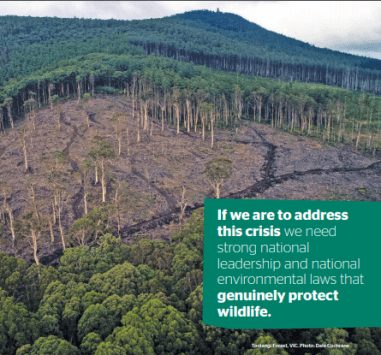
A report entitled “Fast-tracking extinction: Australia’s national environmental laws” was collaboratively prepared by the Australian Conservation Foundation (ACF), WWF, Wilderness Society and the University of Queensland and published in September 2018. The central theme of the report the effects of deforestation on Australian wildlife. The full report can be viewed here: https://d3n8a8pro7vhmx.cloudfront.net/auscon/pages/6451/attachments/original/1536271571/08-2018_16pp_ACF_Fast-Tracking_Extinction_report_final_WEB.PDF?1536271571

While Australia is home to an extensive range of native animals, unfortunately, it is the leading country worldwide in terms of mammal extinction rates (Woinarski, 2011). Habitat loss is amongst the largest reasons for extinction and the decline of species on a global scale.

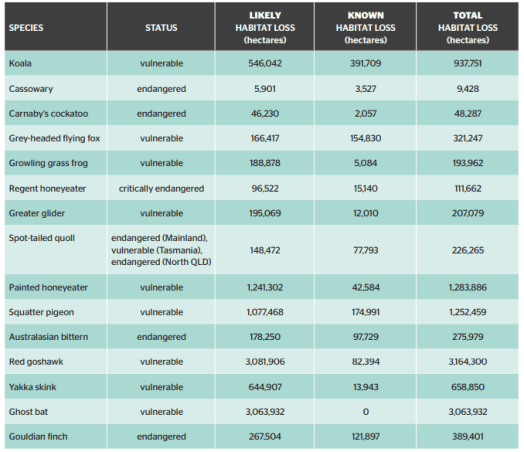
Habitat loss for threatened species may be broken down into two types: known habitats and likely habitats. Known habitats, as the name suggests, are areas which are known locations of threatened species. Likely habitats are areas in with preferred conditions and geographical locations for threatened species are found. The Australian Conservation Foundation (2018) estimates that a total 7.47 million hectares of habitat have been lost, when considering both known and likely habitats, since the Environment Protection and Biodiversity Act 1999 (EPBC Act) was first enacted in 2000.

The intention of the EPBC Act was to protect threatened and endangered species as well as their habitats. The Act established a process of approval for activity with a potentially significant impact in these areas. However, the figures in the following table, sourced directly from the ACF 2018 report, suggests that the measures currently in place are not stringent enough to provide the intended protection.

vunerable species

The report offers recommendations for improving current conditions for threatened species and slowing the rate of habitat loss, largely consisting of suggested changes to national legislation and a closer analysis of projects being undertaken.

habitatloss


References

Australian Conservation Foundation, (2018). Fast-tracking extinction: Australia’s national environmental law. Retrieved from: https://d3n8a8pro7vhmx.cloudfront.net/auscon/pages/6451/attachments/original/1536271571/08-2018_16pp_ACF_Fast-Tracking_Extinction_report_final_WEB.PDF?1536271571

Woinarski, J. C. Z. et al. (2011) ‘The disappearing mammal fauna of northern Australia: Context, cause, and response’, Conservation Letters, 4(3), pp. 192–201


Spelling, Grammar and Presentation

The importance of using correct spelling, grammar and presentation when communicating ideas and information in professional contexts should not be overlooked. Communication involves a sender transmitting a message to the intended audience, or receiver. To ensure that the receiver hears the sender’s message as it is intended, the sender must take measures to reduce noise that influences how the message is interpreted and understood (Cenere, 2015).

In the context of written communication spelling grammar and presentation all have the ability to distract the receiver from what the sender is trying to convey (Cenere, 2015). Written communication does not give the reader the ability to interpret visual or audible cues such as body language or tone, therefore it is vital that the message is presented clearly and with minimal distraction in order to avoid miscommunication of the message.

The quality of an employee’s spelling grammar and presentation may also play a role in how they are perceived by employers. For instance, if an employer receives an email with extensive spelling and grammar mistakes it may indicate the employee/potential employee attained formal qualification but is still unable to communicate well, or that social etiquette is lacking, or that there is limited levels of focus and attention to detail (Cenere, 2015). None of these are sought after qualities when an employer is selecting the best candidate for a new position or promotion.

Spelling, grammar and presentation are equally as important when using written forms of communication during interaction with customers or clients. Quality of writing in this context gives the receiver an impression as to how knowledgeable the sender is in regards to the subject they are discussing. Correct use of language also ensures that the risk of miscommunication is kept to a minimum (Nounplus, 2017).


References

Cenere, P., Gill, R., Lawson, C., & Lewis, M. (2015). Communication Skills for Business Professionals. Cambridge: Cambridge University Press

Nounplus Blog. Why is grammar important in business communication? (2017). Retrieved 6 August, 2018 from Blog: https://www.nounplus.net/blog/why-is-grammar-important-in-business-communication/


Welcome


Welcome to my Communications Blog. Please join me in discovering the importance of communication in professional contexts by discussing five relevant topics.


Design a site like this with WordPress.com
Get started